Breeder, Sort Of

Back in February 2006, I purchased a barren Broad Brush mare at the Fasig-Tipton Kentucky mixed sale. I did some research, tried to select a good match for her, and sent in a mare nomination form. The next month, I brought her to Ashford Stud for a date with Honour and Glory (on SRO). They danced, my mare came back to the farm and gestated the requisite 340-odd days, and then we had a new colt. When I filled out the registration for The Jockey Club, I carefully filled in my name under the field for "Breeder."

Now it's May 2007. The Broad Brush mare goes back to Honour and Glory (who's now at Wintergreen Stallion Station) -- I chose to breed her back to the same stallion because I liked the cross and her suckling colt looks like a real winner. I transport my mare in for her cover, bring her back to her stall (where her little foal is frantically awaiting her return), and again wait the 11-plus months for a new foal to develop.

Fast-forward to April 2008. The mare has spent the last 15 nights in the foaling stall -- the same stall she used last year. Then -- finally! -- the foal arrives this morning, a nice-looking bay filly with rear pastern socks, a star and snip. My choice to send this mare back to Honour and Glory looks absolutely inspired. And thanks to a year's worth of loving care and smart feeding, I've helped to create this beautiful new girl.  When it comes time to register the young lady, what name will proudly be inserted as breeder?
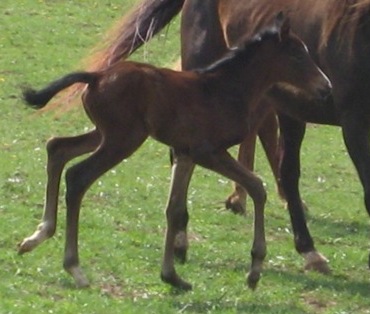
 If you guessed "Scot," you're wrong!

Last evening (Saturday), I sold the mare. I'll still care for her for the next week or so before she and her little one head off to their new digs. But because the mare was sold before foaling, it will be the new owner's name that goes down as "breeder."  Per The Jockey Club's rules (specifically, Section III of the American Stud Book Principal Rules and Requirements), a foal's breeder is the owner of its dam at the time of foaling.  This mare's new owner became a breeder about 12 hours after his purchase! (As we'd agreed beforehand in negotiations of terms for the sale.)

It used to be a quirky rule that didn't affect much beyond pride and bragging rights, but nowadays the "breeder" can reap some serious benefits. Breeders' incentive plans in a bunch of states make the title more than just a name on the registration page. Being the named breeder can be rewarding. It can mean big money for the breeder, even if he sells the horse before its racing career. And Kentucky's new incentive program is lucrative. But the breeder of a foal is the current owner of its dam, not the person who planned the mating and saw it through to birth. So if this filly goes on to win mllions, I'll be just another fan watching from the stands -- devoid of a financial stake in her success.

It's an odd system, isn't it?

20 Apr 2008
8:58 PM

Comments

Blog trackback

The Five-Cross Files 21 Apr 2008 2:07 AM

It would make sense when selling privately an in-foal mare to include a clause for the seller to be listed as co-breeder.  Most mare purchasers would not object to this.

  • Scot's reply:  Good point!  That's a good solution for situations like this.   In the case of my Broad Brush mare, the new owner wanted to be the sole breeder and that was factored into the price for the mare/foal package. 
Gracie 21 Apr 2008 9:21 AM

I've always found this to be an odd rule.  Other animal breeds I've been involved with (dairy cattle, beef cattle, dogs, other horse breeds) all consider the breeder to be the owner of the dam at the time of mating.  I think Thoroughbreds are pretty unique in using time of foaling as the determinant.

LanceS 21 Apr 2008 2:25 PM

This is an odd rule. And I believe only TB's have the rule presented this way. QH's the breeder is mare owner at time of breeding (get it "breeding", thereby breeder the one who decided on the "breeding"). The standard understanding should be owner at time of breeding and the seller throws in the co-breeder as an added sales incentive not the other way around. Weird world we live in.

Caleb 21 Apr 2008 4:39 PM

You obviously wanted to sell the mare before she foaled. The current rules provide much more flexibility and I am sure these considerations are factored into the price of the pregnant mare giving you much more liquiditiy in the sale. If not for this allowance you might have been left no option but to foal her yourself and then try to sell the foal and new born filly. Depending on how the new filly looked---you might not have been able to sell her at all.....The current system provides much more liquidity

portbay 21 Apr 2008 10:24 PM

lets move on here...no problem with that rule...the jocky club folks are some of the best folks in this game of wierd ones!!!

Bellwether 22 Apr 2008 12:57 AM

Well-known breeder, Rob Whiteley, questioned the rule in an article written for BloodHorse a year or more ago.  No readers took up the matter.  Fair to assume nobody cares.

Fact is, the system suits the bureaucrats at The Jockey Club, so it is unlikely to change.

Must disagree with BELLWEATHER'S rating of TJC folks as "some of the best".  Has he ever tried describing the markings on a Registration form?  Even when it's own tips and definitions are followed, the TJC pedants will write the Certificate another way.  Example - if you write a marking is 'Higher on the right', the Cert will read 'Lower on the left'.

If TJC is "best folks", we are in real trouble.

By the way, 'weird' is spelled wEIrd; or does the Jockey Club disagree?

Redmond 22 Apr 2008 1:50 PM

It seems like there are a lot of people doing analysis of pedigrees, without anybody really applying statistical analysis and 'scientific' research methods to the data to see which theories and patterns have predictive value.  

For example, people spend a lot of time finding examples of successful 'nicks' between various sires and broodmare sires' lines...but I've never seen an attempt to determine whether the past results of these have statistical significance based on the sample size and variance of the data.  I've also never seen a study that did backtesting on an unbiased sample of nicks that had similar results to see if there was any predictive value.

Am I just unaware of an existing body of research (very possible), or is nobody using these techniques to study racing pegigrees?

  • Scot's reply: Several good questions.  Thus far, no nicking program has looked at all horses bred on a particular pattern, so no valid statistical analysis has been possible.  The TrueNicks system, which does look at every attempt at a particular cross, will change that. TrueNicks evaluates solely on overall statistical performance of the cross.  (For example:  Barbaro rates a C based on the average performance of the overall Dynaformer / Mr. Prospector cross -- big name horses don't get special treatment!)  Now that a nicking program has been devised using a complete statistical database, you can be sure that you'll see studies that examine predictive value.  When that happens, I'll point to the reports here at The Five-Cross Files!
Alex 24 Apr 2008 7:22 AM

Scott - Thanks for the thorough reply.  I actually meant the question more generally...is anyone doing that kind of statistical analysis on ANY aspects of the breeding industry?  Are people doing statistically valid studies on things like whether money is better spent at yearling auctions vs. two year old auctions, whether a broodmare's racing results are more or less significant in predicting future success of her children than the success of her previous children, whether AEI/CI is the best predictor of future success for sires, etc.?

  • Scot's reply:  You will find some of this statistical analysis in TBH MarketWatch. Your last comment hit on an important point: sample size for individual sires is often too small to be statistically significant for most research studies. One of my goals as research editor is to initiate studies that might identify trends based on larger classifications ("sires with AEI at least 1.5 times CI vs. sires with multiple graded wins vs. sires with inbreeding at least 3x3" or "crosses of Mr. Prospector-line sires vs. Northern Dancer-line sires over female family #1") rather than on individual horses.  Part of the fun of horse racing is that it can't all be explained or perfected by looking at numbers -- but looking at numbers does give you an upper hand.  It's about time to see how much of an advantage real in-depth review could yield.
Alex 24 Apr 2008 10:59 AM

As former breeders, we found the JC breeder rule an incentive to buy in-foal mares. We'd foal, rebreed and sell both mare and foal. Risk and reward - equal. My family has bred and sold dairy cattle. The cattle breeder is the owner at time of conception and the breeder's "Prefix" becomes part of the animal's name upon registration by the new owner. Frankly, I'd rather be on record for planning/selecting a mating, than for purchasing someone else's theory.

R 24 Apr 2008 3:45 PM

I find commercial horse breeding very distressing on many levels..

But most of all that people callously sell brood mares right before or after they foal - without any regard to the mare's well being. Horses are herd animals and like familiar surroundings when foaling and caring for their foal..

I would think I would rather keep the mare and be the real breeder..

I feel that the best interest of the horse should come first - not breeder name technicalities.

Anne Mayea 27 Apr 2008 9:38 PM

It will not hurt the mare or foal for paperwork to change hands before the foaling. It will not disturb her to care for her foal for a couple weeks and then both of them move. the best interest of the horse IN NO WAY SHAPE OR FORM was callously treated!!!

Stephanie 30 Apr 2008 10:19 PM

Leave a Comment

All comments are moderated and must be approved before they are posted. The blog author reserves the right to edit or omit any comment.

  (Appears with your comment) (required)
  (Will not be published) (required)
  (required)